Black holes, explained way too simply
The one-sentence version
A black hole is so much stuff squeezed into so little space that nothing that falls in, not even light, can climb back out.
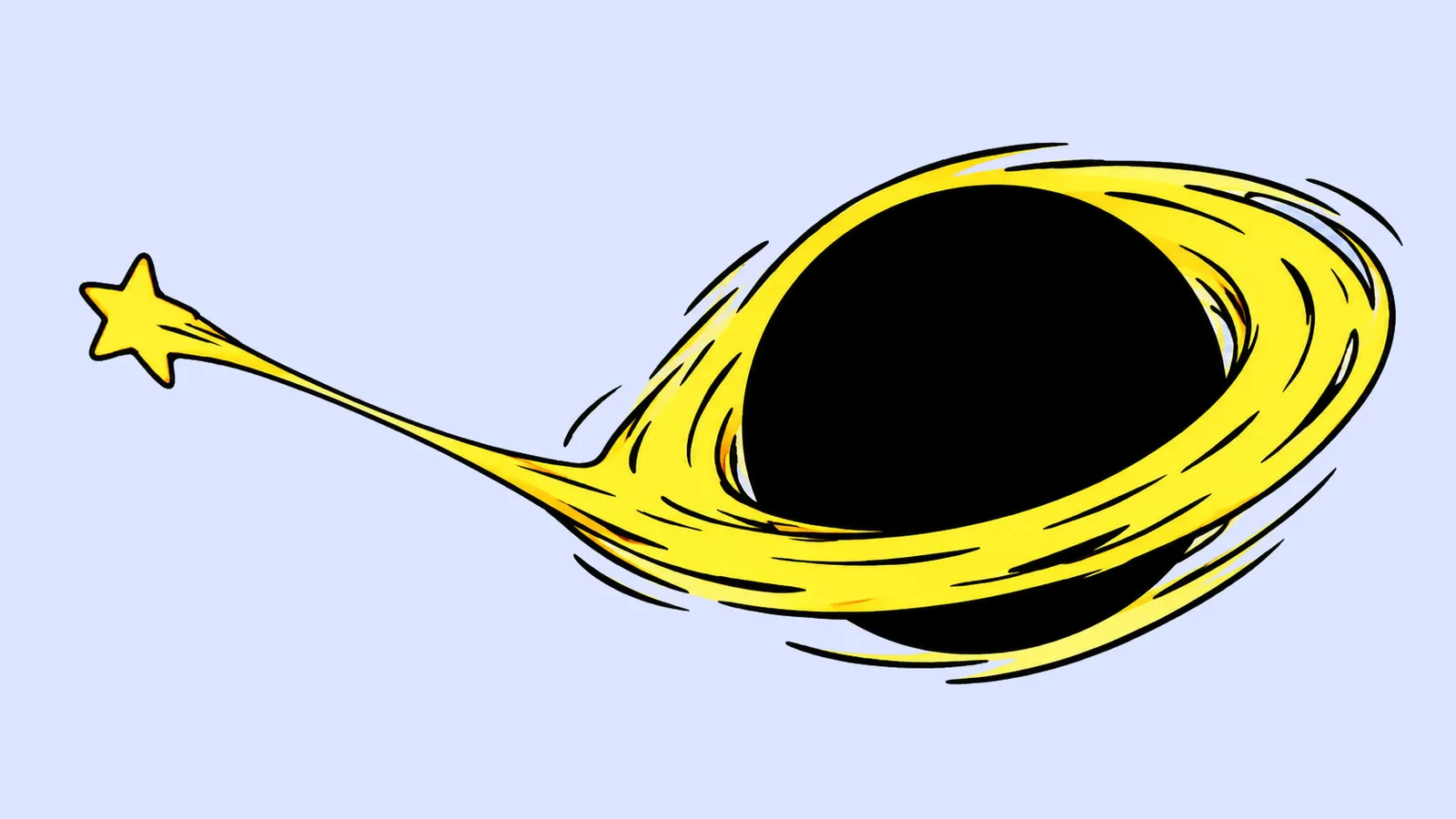
Video coming soon
The slightly longer version
Squeeze something hard enough
Everything with mass pulls on everything else. The Earth pulls on you, which is why you stay on it. To leave Earth for good, a rocket has to go about 11 kilometres a second. That’s Earth’s escape speed.
Now squeeze the Earth smaller without taking any stuff away. The pull at its surface gets stronger, and the escape speed goes up. Squeeze it down to the size of a marble and the escape speed would be faster than light. Nothing goes faster than light, so nothing gets out. Congratulations: a black hole.
Where they come from
Nobody squeezes planets. But very big stars do it to themselves. When a star many times heavier than the Sun runs out of fuel, there’s nothing left pushing outwards against its own weight, and the core collapses. If it’s heavy enough, nothing can stop the collapse.
The point of no return
Around every black hole there’s an invisible line called the event horizon. Outside it, you can still escape if you’re fast enough. Inside it, every direction leads further in. It isn’t a surface; you wouldn’t feel anything special crossing it. You just couldn’t come back.
They don’t suck
A black hole isn’t a vacuum cleaner. From far away it pulls exactly like anything else of the same mass. If the Sun were swapped for a black hole of the same weight, the Earth would carry on orbiting as before. It would just get very cold and very dark.